
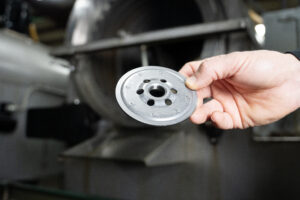
 Long-life stamping tooling isn’t the industry norm. Most stamping dies are budgeted, built, and disposed of on program cycles that last five to seven years. When the program refreshes, the tool gets rebuilt or replaced. That’s how automotive procurement is set up. That’s how most stamping suppliers price. And that’s how most tooling actually behaves.
We do it differently, and we have decades of documented production data behind the different approach. One of our stamping tools ran continuously from the mid-1990s until 2023 for an Oil Filter OEM, producing a variety of 16 different part number filter plates the entire time. Over 20-plus years, that single die produced more than one billion parts.
It wasn’t the only one.
The numbers
Across the full Oil Filter OEM relationship, our filter plate tooling produced well over three billion parts. Two and a half billion of those are documented back to 1996. The tool that produced a 3″ diameter tapping plate alone accounted for more than one billion pieces across roughly 20 years of continuous production. A related 3″ diameter tapping plate die, first put into production in 1988 and still producing when the customer relationship ended in 2023, ran for 35 years and produced 112 million pieces on that specific tool. Related tooling in the same family added hundreds of millions more.
Filtration wasn’t the only industry where our tooling ran that long.
We built two dies for an NVH Tier 1 supplier in 2003 for F-150 front strut mount production. Those tools have been running continuously ever since. Same base tool, produced slightly modified parts through multiple truck program refreshes, still in production 23 years later.
A 2-5/8″ tapping plate die produced close to half a billion parts across its production life. Still recoverable today: if we pulled that die out of storage, we could start running parts within a shift.
The pattern isn’t a fluke. It’s how we build tooling on purpose.
What “maintained for life” actually means
We charge for the die once, upfront, at the start of the program. Sometimes at a premium to what our competitors quote, sometimes not. Either way, that’s the last invoice the customer sees for that tool, even when the program runs well beyond the original scope.
After the initial build, we maintain the die for the entire life of the part at no additional charge. When inserts wear out, we replace them. When sections need attention, we take care of them. When precision degrades enough that the tool needs to be brought back to spec, we do that too. The customer never sees a tooling maintenance invoice.
We also build additional tools at our own cost when customer volume grows enough to require them. In the case of one filter plate family, we ended up building three matching tools with interchangeable die sections. The customer paid for the first tool. We built the second and third to meet their volume demand without charging for the additional capacity.
The economics work because the tools last. When a die runs a billion parts across 20-plus years, the amortized cost of the maintenance and the additional tools is a small fraction of what those customers would have paid for equivalent tooling from a supplier operating on the traditional replace-per-program-cycle model. The initial investment buys them out of the maintenance cost curve for the life of the part.
Why most suppliers can’t do it
The model requires three things most stamping suppliers don’t have simultaneously.
The first is engineering and toolmaking capability strong enough to build tools that actually last. Long-life dies aren’t just dies that got built well and got lucky. They’re dies designed from day one with material selection, insert strategy, and maintenance access engineered for a 20-plus year production window. That requires in-house tool and die design, not outsourced tooling.
The second is toolroom capability strong enough to maintain them over decades. Every long-life die needs regular attention: insert changes, section rebuilds, precision restoration. A supplier who doesn’t have full toolroom capability in-house has to either send tools out (adding cost and lead time) or let them degrade. Neither works over a 20-year window.
The third is the financial patience to eat the maintenance cost. A stamping supplier operating on tight quarterly margins can’t afford to maintain a tool for two decades without charging for it. The math only works if the shop has the balance sheet to absorb ongoing maintenance and the customer relationship strong enough that repeat business over decades justifies the upfront investment. That’s a hard combination for a supplier that’s optimizing for a private equity exit or a supplier that’s undercapitalized to begin with.
Family-owned shops with multi-generational operating histories have a structural advantage here. So do shops with full in-house tool and die and toolroom capability. Not many suppliers check both boxes.
Why long-life stamping tooling matters more now than it used to
Two things have shifted in the last five years that make long-life tooling more valuable than it was when the 3″ tapping plate die was first cut in the mid-1990s.
The first is the acceleration of ownership churn in supplier bases. Private equity acquisition, spin-offs, roll-ups, and bankruptcy proceedings have moved dozens of stamping suppliers through multiple ownership transitions in a short window. It’s a pattern we recently covered in more detail on the filtration industry consolidation post. When a supplier’s ownership changes, their tooling strategy often changes too. Programs that were promised long tool life get resourced. Maintenance commitments get renegotiated. Customers who assumed their supplier relationship was stable find themselves back in market for new tooling on parts that were supposed to be locked in.
A supplier whose family ownership has been stable through four generations, and whose tooling has demonstrably survived across the same 30-year window that other suppliers went through three ownership changes in, offers a specific kind of supply chain resilience that the market is increasingly willing to pay for. That’s part of why we’ve seen so much automotive takeover work reach us in the last two years.
The second shift is the rising cost of new tooling. Steel prices, machining labor, and lead times for major tool builds have all inflated significantly since 2020, tracking the broader increases visible in producer prices for iron and steel. A program that could tolerate rebuilding tooling every five to seven years when the die was $80,000 doesn’t look the same when the die is $180,000. The math on long-life tooling gets stronger every year.
Where the model runs into buyer resistance
We know the model isn’t the easiest sell.
Procurement managers with three-to-five-year horizons don’t always internalize a 20-year total-cost-of-ownership calculation. The upfront price gap looks meaningful even when the lifetime cost picture doesn’t. Purchasing organizations at foreign-owned OEMs and Tier 1s that operate on their own countries’ procurement conventions often struggle with the concept of a supplier not charging for tooling maintenance at all. They expect a maintenance line item. When they don’t see one, they assume it’s coming later.
The customers who understand it, understand it deeply. F-150 program buyers who signed with us in 2003 have watched the same tool run through five presidential administrations. They understand what that stability means to their program economics. New buyers evaluating us for the first time sometimes need to be walked through the math before the model clicks.
Where we fit
We’re a fourth-generation, family-owned precision metal stamping manufacturer in Celina, Ohio. Since 1948, we’ve been building tools designed to last across the full life of the parts they produce, and maintaining those tools without charging our partners for the maintenance. In-house tool and die design, in-house tool build, in-house toolroom, and the multi-generational operating history to make the whole model work economically. Progressive die, transfer die, and compound die tooling all built to the same standard.
If you’re evaluating stamping partners and want to talk through what long-life tooling would mean for your program’s total cost picture, we’re set up for that conversation. Send us your specs and volume expectations. We’ll get you a clear answer.
Bottom line
Long-life stamping tooling isn’t standard practice in the industry, but it’s not impossible either. It requires in-house engineering, in-house toolroom capability, and enough financial patience to absorb the maintenance cost across the life of the part rather than charging for it every few years. Where those three conditions come together, tools can run for 20 to 30 years and produce billions of parts across a single die family.
We’ve built our operation around that model since 1948. The 30-year tool life isn’t marketing. It’s what shows up in our production data.